
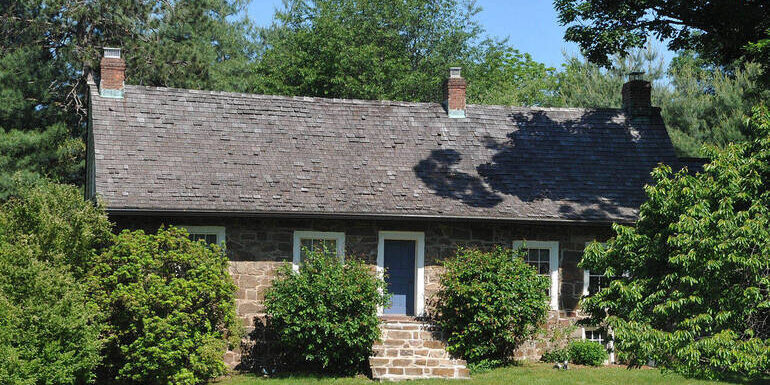
MONTVILLE, NJ – Located at 29 Changebridge Road, the Van Duyne–Jacobus House stands as a rare and remarkably preserved example of early Dutch Colonial architecture in Montville Township. This one-and-a-half-story stone house was constructed in two unequal sections. The larger, southwestern portion—with its prominent central chimney—dates back to before the American Revolution. The smaller, northeastern section was likely added in the 1830s, creating the home’s distinctive asymmetrical layout.
The property’s roots trace back to April 1737, when Martin Van Duyne, Sr., one of Montville’s earliest settlers, purchased a 65.5-acre tract from Daniel Worms. Van Duyne had already acquired a nearly 200-acre farm near Towaco in 1730 and continued expanding his landholdings through the 1730s and ’40s, establishing a lasting presence in the area.
By 1776, Martin Sr. divided his extensive properties among his sons—Martin Jr., James, and Abraham. Martin Jr. inherited the Changebridge Road tract and further expanded it by purchasing an additional 56 acres in 1761. It was likely under Martin Jr.’s ownership that the original stone section of the house was built. He lived on the property until his death in 1811, after which the house passed to his son, Richard Van Duyne.
Richard maintained ownership until his death in April 1847. During his tenure, the house underwent a significant renovation. Fireplaces were remodeled in the then-fashionable Greek Revival style, and the front entry was relocated—alterations that added 19th-century refinement while preserving the home’s historic foundation.
Shortly after Richard’s death, his son Isaac inherited the house. He soon borrowed $400 from a neighbor, Josiah Zabriskie, using the farm as collateral—likely to pay off cash legacies from his father’s estate.
Find out more about the Van Duyne House by reding the full article at TAPIntoMontville.